TikTok slideshow vs video: which should you post?
TikTok slideshow vs video: three 2025–2026 studies disagree on engagement. What each one measured, what each format takes, and when to post which.
· Updated · 6 min read · by Reelazy
TikTok slideshow vs video is less a fight than a question about what you have to say and how often you can say it. Still, people want a number, so here are the three largest recent studies, what each one actually measured, and why their answers point in different directions.
After that: what each format takes to make, and a simple rule for which one to use for a given idea.
TikTok slideshow vs video: what the studies found
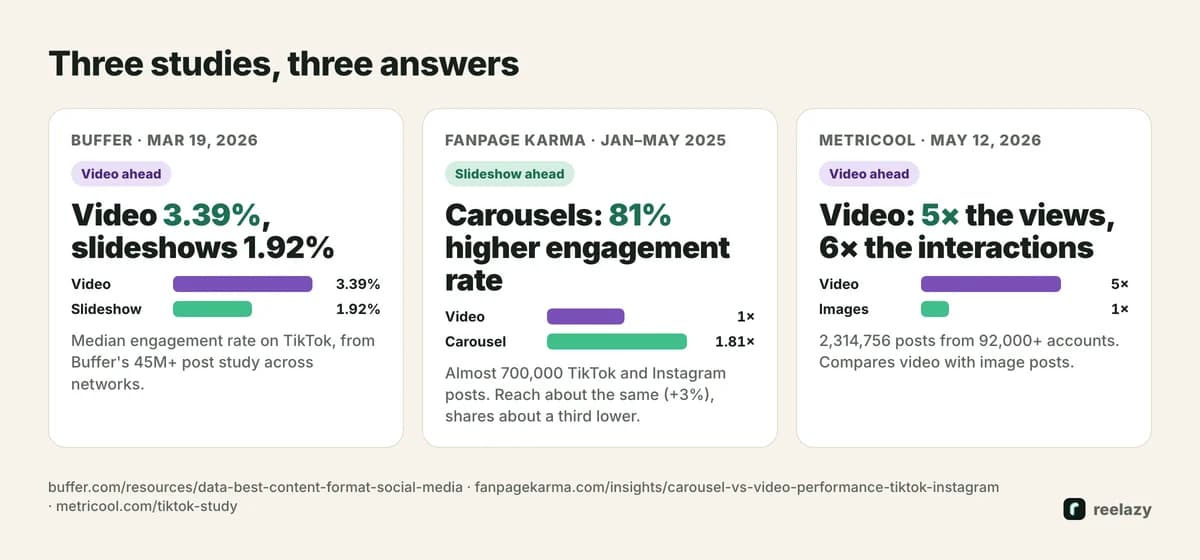
Buffer, March 19, 2026. From its study of 45 million posts across networks, Buffer reports a median engagement rate on TikTok of 3.39% for video and 1.92% for carousels and photo posts, so video is 77% higher (Buffer). It doesn't give the TikTok sample size or define engagement rate for TikTok.
Fanpage Karma, posts from January to May 2025. Across almost 700,000 TikTok and Instagram posts, TikTok carousels had an engagement rate "more than 81% higher" than videos, almost 82% more likes, reach about the same (3% higher), and about a third fewer shares (Fanpage Karma).
Metricool, May 12, 2026. From 2,314,756 posts by more than 92,000 accounts: "Video gets 5x more views and 6x more interactions than images" (Metricool). It also says its users published 72% more videos and 140% more image and carousel posts.
Why they point different ways
- Rate versus totals. Fanpage Karma and Buffer compare engagement rates. Metricool compares totals per post. A format can get fewer views and still a higher share of viewers who like it.
- Median versus average. Buffer uses the median, which ignores the few huge posts. Averages lean toward them.
- Whose accounts. Each study uses its own customers' posts, and the kinds of accounts that post slideshows on each tool differ.
- When. Fanpage Karma's posts are from early 2025; Buffer's and Metricool's reports are from 2026.
So "videos get more views" and "carousels get more engagement" can both be true at once. None of the studies looked at accounts like yours, posting your kind of idea.
What each format takes
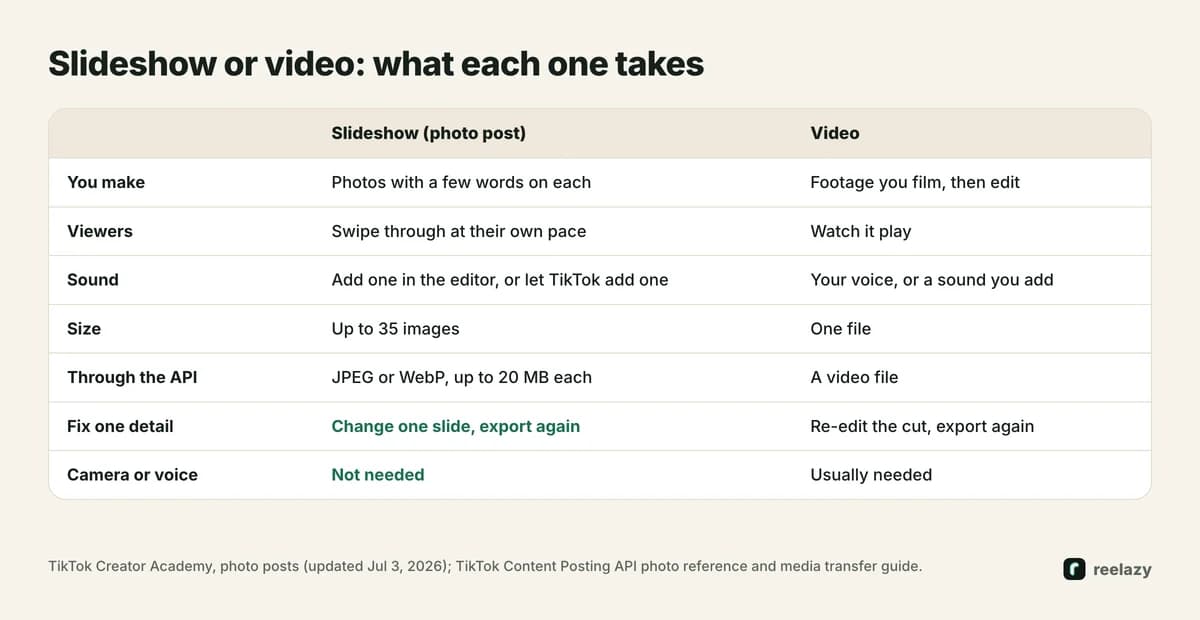
| Slideshow (photo post) | Video | |
|---|---|---|
| What you make | Photos with a few words on each | Footage you film, then edit |
| How people watch | Swipe through "at their own pace" (TikTok) | It plays on its own |
| Sound | Added in the editor, or TikTok's recommended music | Your voice, or a sound you add |
| Size | Up to 35 images, 1080 × 1440 works best | One video file |
| Through TikTok's API | JPEG or WebP, up to 20 MB each (guide) | A video file |
| Changing one detail | Edit one slide, export again | Re-edit the cut, export again |
| Camera or voice | Not needed | Usually needed |
The cost difference is the one that decides it for most small teams. A slideshow is words and photos. A video is a shoot, an edit, and someone willing to be on camera.
When a slideshow is the better choice
- The idea is a list, steps or a comparison. "5 money habits", "3 mistakes", "this or that" are built from separate points, and one point per slide fits them.
- People will want to keep it. Slides are easy to save and come back to. TikTok's own list of themes that work in photo posts includes tutorials, recipes, info sharing and round-ups.
- You need to post often. Five posts a week in video is a production schedule. In slides it is an afternoon.
- Nobody wants to be on camera. Common for app founders, and fine for this format.
- You run several accounts. A format that works can be repeated with new words on each account.
When video is the better choice
- The product has to move. An app's best moment is often on screen: a screen recording of the feature beats a description of it.
- A face builds trust. A founder explaining why they built the app, or a user's honest reaction.
- You want shares. Fanpage Karma found carousels got about a third fewer shares than videos.
- The idea is a story with timing, like a reveal that needs a pause.
The same idea, both ways
Take "3 signs your budget is too strict" for a made-up budgeting app, @yourapp.
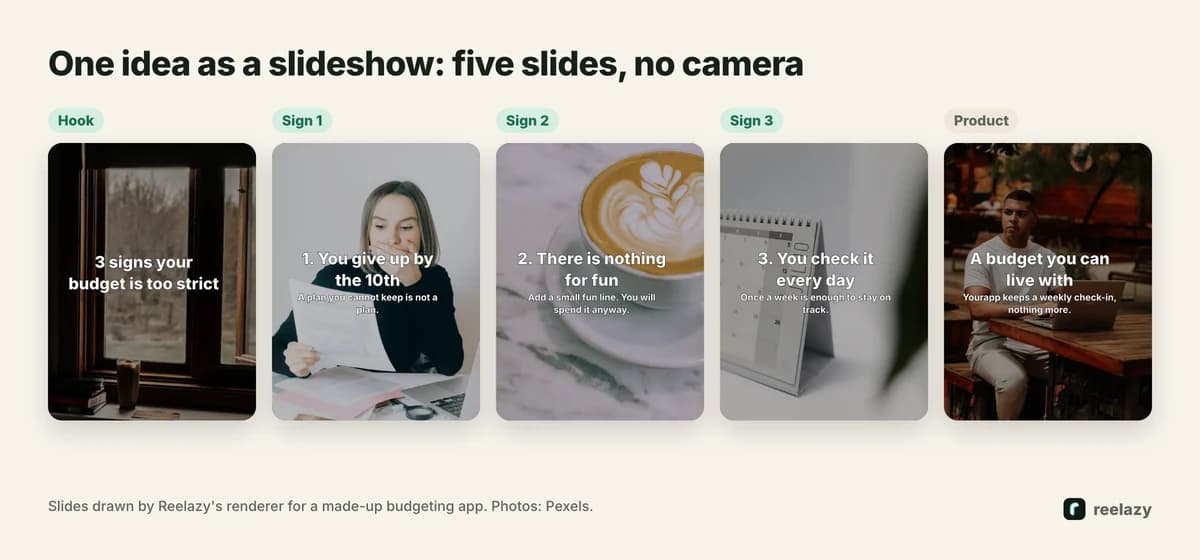
As a slideshow it is five slides: the hook, one sign per slide, and the app as a gentler way. You can write it in ten minutes and make five more like it the same day.
As a video it is a 30-second clip: someone at a kitchen table says the hook to camera, three quick cuts for the signs, and a screen recording of the app's weekly check-in at the end. Better for showing the app itself, much more work to make.
A good split for an app account: slideshows for the steady stream of tips, lists and stories, and a video now and then when there is something to show. If you post slideshows through TikTok's API and want a specific sound, see how to add music to a TikTok slideshow.
How to decide for your account
Run both for a month, on the same topics:
- Post your usual slideshows, and one video a week on an idea you also made as slides.
- Compare per post: views, saves, comments, and visits to your profile.
- Keep the format that wins on the measure you care about. For an app, that is usually profile visits and link taps, not likes.
Slideshows are where Reelazy helps. Find a TikTok slideshow that works, Reelazy copies its format and makes a month of posts like it for your app, with licensed photos or your own, and posts them through TikTok's official API after you approve them. See examples for budgeting apps and fitness apps, the slide formats and the TikTok hooks library, or read the TikTok photo slides guide. Start free: Free includes 2 posts you can schedule to TikTok.
Frequently asked questions
Do TikTok slideshows get more views than videos?
Not in Metricool's 2026 data, where video got 5 times the views of image posts. Fanpage Karma's 2025 data found about the same reach for carousels and videos. The answer depends on the accounts and the content.
Do TikTok slideshows get more engagement than videos?
Fanpage Karma found carousels had an 81% higher engagement rate. Buffer found the opposite, 3.39% for video against 1.92% for carousels and photos. The studies measure different things on different accounts.
Is a slideshow or a video better for promoting an app?
Slideshows suit tips, lists and stories you can post often without filming. Video suits showing the app on screen. Most app accounts use slideshows as the base and add a video when there is something to show.
Can I turn a TikTok slideshow into a video?
Yes. If you pick the photos in video mode instead of photo mode, TikTok turns them into a video that plays on its own. Viewers then can't swipe at their own pace.
Are slideshows easier to automate than videos?
Yes, for most teams. A slideshow is images and text, which an app can make and post through TikTok's Content Posting API. A video still needs footage someone filmed.